
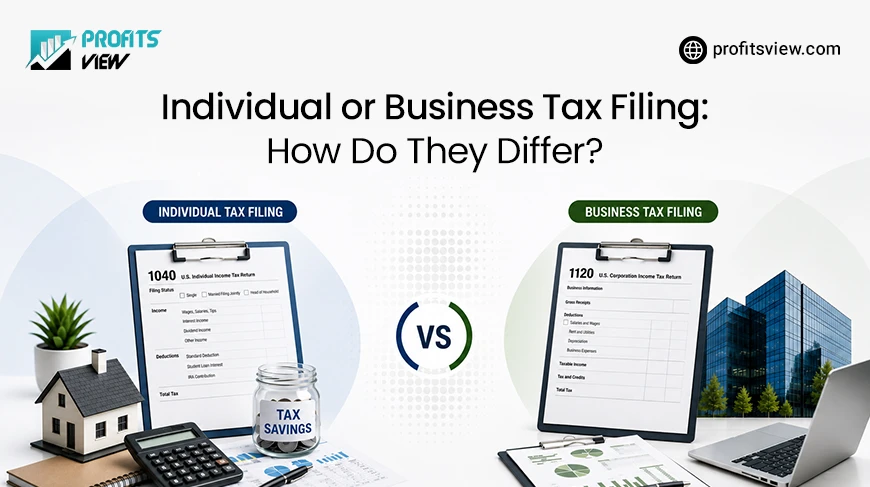
The most important difference between individual and business tax filing is what income you report, what forms you use to file your taxes, what deductions may be available to you in addition to estimating how much tax will have to pay. Form 1040 is thus a different kind of tax form any individual taxpayer would generally use to report personal income -but there are varying forms below it for a business based on its legal and tax structure.
Sole proprietorships typically report business income and expenses on Schedule C along with Form 1040. Use Form 1065 if it is a partnership, Form 1120-S if an S Corporation and Form 1120 for C Corporations.
Knowing these differences can help you select the correct forms, maintain accurate records, and successfully transfer information when filing your taxes.
Quick Answer
Individual tax income, deductions and credits for a person is reported on the Form 1040. Business tax filing uses forms based on business structure to report business income, expenses and other tax information. Certain businesses (like sole proprietorships and many single-member LLCs), will report their business activity directly on the owner’s personal tax return.
What Is Individual Tax Filing?
Individual tax filing consists of the federal tax process through which you report your personal income and any deductions and credits that you may take to cover your IRS. The majority of individual taxpayers will use Form 1040, U.S. Individual Income Tax Return.
Your earnings may derive from various channels, such as:
- Wages and salaries
- Freelance or self-employment income
- Interest and dividends
- Investment income
- Retirement income
- Rental income
- Other taxable income
The tax return also considers the various deductions and credits available to you, which can lower your taxable income or reduce the amount of taxes owed.
Individual Tax Filing Key Features
Some common features include:
- IRS Form 1040: Most individuals use Form 1040 to report their federal income.
- Filing status: Taxpayers typically have a filing status of their choice such as single, married filing jointly, married filing separately or head of household.
- Deductions: The standard deduction or, if they qualify, itemized deductions.
- Credits: Some taxpayers get tax credits based on their income, family situation, education or other circumstances.
- Reporting self-employment income: Individuals who work independently by running their own businesses as freelancers, contractors, or sole proprietors usually report that business activity on Schedule C attached to Form 1040.
Individual federal income tax returns are generally due on April 15 (the deadline can vary if the date falls on a weekend or other federal holiday) for calendar-year taxpayers.
What Is Business Tax Filing?
Business Tax Filing In its simplest definition, business tax filing is the process of reporting a business’s income, expenses, deductions, and other necessary tax information to the IRS.
The forms a business uses vary, but are also largely dependent upon its organizational structure and federal tax classification. Regardless of the type of business, you can be sole proprietorship, partnership, corporation or LLC (limited liability companies) but an LLC has different federal tax treatment based on its ownership and elections.
Here is a simplified overview:
| Business Type | General Federal Tax Treatment | Major Tax Form |
| Sole-Proprietorship | Business income of owner | Schedule C with Form 1040 |
| Single-member LLC | Usually achieves sole proprietorship tax treatment if no corporate election is made | Individual Income Tax Return (Form 1040) + Schedule C |
| Multi-member LLC | Typically taxed as a partnership unless electing for corporate treatment | Form 1065 |
| Partnership | Partnership tax return | Form 1065 |
| S corporation | Tax return — S corporation tax return | Form 1120-S |
| C corporation | Tax return of C corporation | Form 1120 |
An LLC can have a tax election that alters the way it is treated for federal tax purposes, therefore the term “usually” is important.
Reporting for business tax filing may include:
- Business revenue
- Cost of goods sold
- Operating expenses
- Payroll expenses
- Equipment and depreciation
- Business interest
- Advertising and marketing expenses
- Other eligible business deductions
You may also be required to file estimated tax payments for the year, employment tax returns, or information returns based on the business and your circumstances.
Another thing to keep in mind is whether you’re filing taxes as an individual or as a business.
What Income Is Reported?
Individual tax returns report an individual income and tax information.
Business tax returns are typically formulated on the profits or expenses made by the business. It should be noted, however, that business income does NOT equal a separate return filed for the business.
Sole Proprietors, for example, usually report business income and expenses on Schedule C as part of the owner’s Form 1040.
In contrast, a C corporation typically files its Form 1120 using its own Employer Identification Number and is a separate taxpayer for federal income tax purposes.
Which Tax Forms Are Used?
Individuals generally use Form 1040.
Your form of business depends on the type of business you have and how it is taxed. Common forms include:
- Schedule C: Profit or loss from business — sole proprietorship and some single-member LLCs
- Form 1065: Partnership Tax Return
- Form 1120-S – Income tax return for an S corporation
- Form 1120: Income tax return for C corporations
Depending on your situation, additional schedules and forms may be required.
What Deductions Are Available?
There are many different classes of deductions available to individuals and businesses.
An individual taxpayer might be eligible to write off specific deductions based on their circumstances, such as the standard deduction.
In general, businesses are allowed to deduct certain expenses related to the operation of their business. Examples can include:
- Employee wages
- Rent
- Advertising
- Business insurance
- Professional services
- Supplies
- Certain travel expenses
- Equipment and depreciation
- The business expenses of more common and necessary Types
Before claiming for any business expense, one should first check that the criteria set by the IRS is met before deduction.
What Are the Filing Deadlines?
A taxpayer, business structure and tax year may all influence the date to file taxes.
For most calendar-year individual taxpayers, Form 1040 is due on April 15.
Individual returns tend to have much later filers compared to partnerships and S corporations. Forms 1065 and 1120-S for calendar-year entities More generally, a return is due on the 15th day of the third month after the end of the tax year.
C corporations typically file Form 1120 by the 15th day of the fourth month after their tax year ends.
Taxpayers should always refer to the IRS filing instructions for the years that these changes are effective and carry both general and specific rules as weekends, holidays, extensions or even different tax years can impact deadlines.
How Is Recordkeeping Different?
Because businesses have to record business income and expenses over the course of the year, they typically have more detailed recordkeeping requirements than individuals.
Good business records may include:
- Sales records
- Bank statements
- Receipts
- Invoices
- Payroll records
- Expense records
- Equipment purchases
- Loan documents
- Mileage and travel records
Separating personal and business expenses can assist with easier bookkeeping and tax preparation.
Individual and Business Taxes: Can You File Both?
Yes, based on your business structure and when you are taxed as a taxpayer.
The majority of business owners have both a tax return for the business, as well as an individual tax return.
The information they will include with their Form 1040 (for example, a sole proprietor generally reports business income and expenses on Schedule C).
Usually, a partnership files Form 1065, and each partner may receive a Schedule K-1 that lists their share of the partnership’s income, losses or other tax items. In general, the partner reports that information on their own return.
Similar to one, S corporations will file Form 1120-S and will usually provide the shareholder with Schedule K-1 information that they use for their personal tax return.
This means that a C corporation typically files its own Form 1120 while its owners might have separate individual tax liabilities based on whatever they take from the corporation.
What Type of Tax Filings Are Right For You?
Depending on how you earn income and whether your business is a sole proprietorship or corporation, will determine what kind of taxes you need to file.
- File an individual return (i.e. use Form 1040) when you are a W-2 Employee without other business or significant incrimination income.
- Freelance or independent contractor: Self-employed income and expenses can be reported on Schedule C with your Form 1040.
- You choose to operate as a sole proprietor: Your business income and expenses are — in most cases reported on Schedule C with your individual return.
- Single-Member LLC: Unless it elects to be treated as a corporation, the single-member LLC is typically treated as a so-called disregarded entity for federal income tax treatment.
- You have a partner or a multi-member LLC: The business typically files Form 1065 unless the LLC has elected to adopt corporate treatment.
- You have an S Corporation: The corporation typically files IRS Form 1120-S, and the shareholders generally report their share of income from the operation on the Form 1040 personal returns.
- You have a C corporation: Form 1120 is filed for the corporation; owners pay taxes separately on income received.
Things Not to Do When Filing Taxes
Mixing Personal and Business Expenses
It can complicate bookkeeping and make it more difficult to justify business deductions in the proper manner when you are using the same accounts and records for personal vs. business expenses.
Maintaining a separate set of business records and accounts can help to identify genuine business deductions, making filing tax returns easier.
Missing Estimated Tax Payments
Workers who are self-employed or if you own certain types of business might be responsible for estimated tax payments throughout the year, as those payments are not deducted from their business profits automatically.
Yet, estimated tax requirements vary based on the circumstances of the taxpayer. But that doesn’t mean all businesses stick to the same quarterly payment responsibility by way of their profits.
Poor Recordkeeping
Incorrect amounts, missing receipts, no record of income in a business with expenses but no other indication can create issues in preparing taxes to be prepared.
It is usually much easier to keep track of accurate records during the year than it is to try and recreate everything at tax time.
Choosing the Wrong Tax Classification
The legal structure of an LLC doesn’t directly indicate how it will be taxed federally. Federal Tax Treatment Varies With Ownership and Elections Made up of as few as one person, an LLC can be federally taxed in the following ways based on its ownership structure:
If you are uncertain about how your business should be classified, seeking advice from a knowledgeable tax professional may help.
Missing Filing Deadlines
Different forms have different deadlines. If you fail to meet a filing deadline, you may face penalties or other tax consequences.
Business owners must monitor both federal and state filing requirements, as well as any current deadlines for the tax year at issue.
Individual vs LLC Tax return filing: Quick Overview
Then training on the data that was present at October 2023.
| Feature | Individual Tax Filing | Business Tax Filing |
| Primary use | Individual — Reports personal income and tax information | Business — Reports business income and tax information |
| Tax form | Core Form 1040 | 1065, 1120, 1120-S or Schedule C by structure |
| Declare income | Wagering, investments, self-employment income and other personal income | Your business earnings and some other business-related |
| Deductions | Standard or itemized deductions and other eligible write-offs | Eligible business expenses and other corresponding deductions |
| Recordkeeping | Personal income and deduction records | Detailed records of income, expense, payroll, and business data |
| Filing deadline | Most individual calendar-year taxpayers: April 15 | Business type and tax year dependant |
The Bottom Line
Personal tax returns typically declare an individual income as well as the associated deductions and credits, using IRS Form 1040. Business tax filing is generally recorded on business-specific forms that are largely determined by the ownership structure and federal tax classification of your business.
The two can overlap. For instance, a sole proprietor almost always has business activity reported on Schedule C which is part of an individual Form 1040. Partnerships, S corporations and C corporations are typically subject to business-level filing requirements.
The appropriate filing method depends on how exactly your business is structured, how it is taxed and what type of income you earn. Because tax rules and filing deadlines may change, an individual should always refer to the most recent IRS guidance or contact a qualified tax practitioner prior to filing.